Tangier Becomes the New Nerve Centre of Africa’s Blue Port Revolution

Share
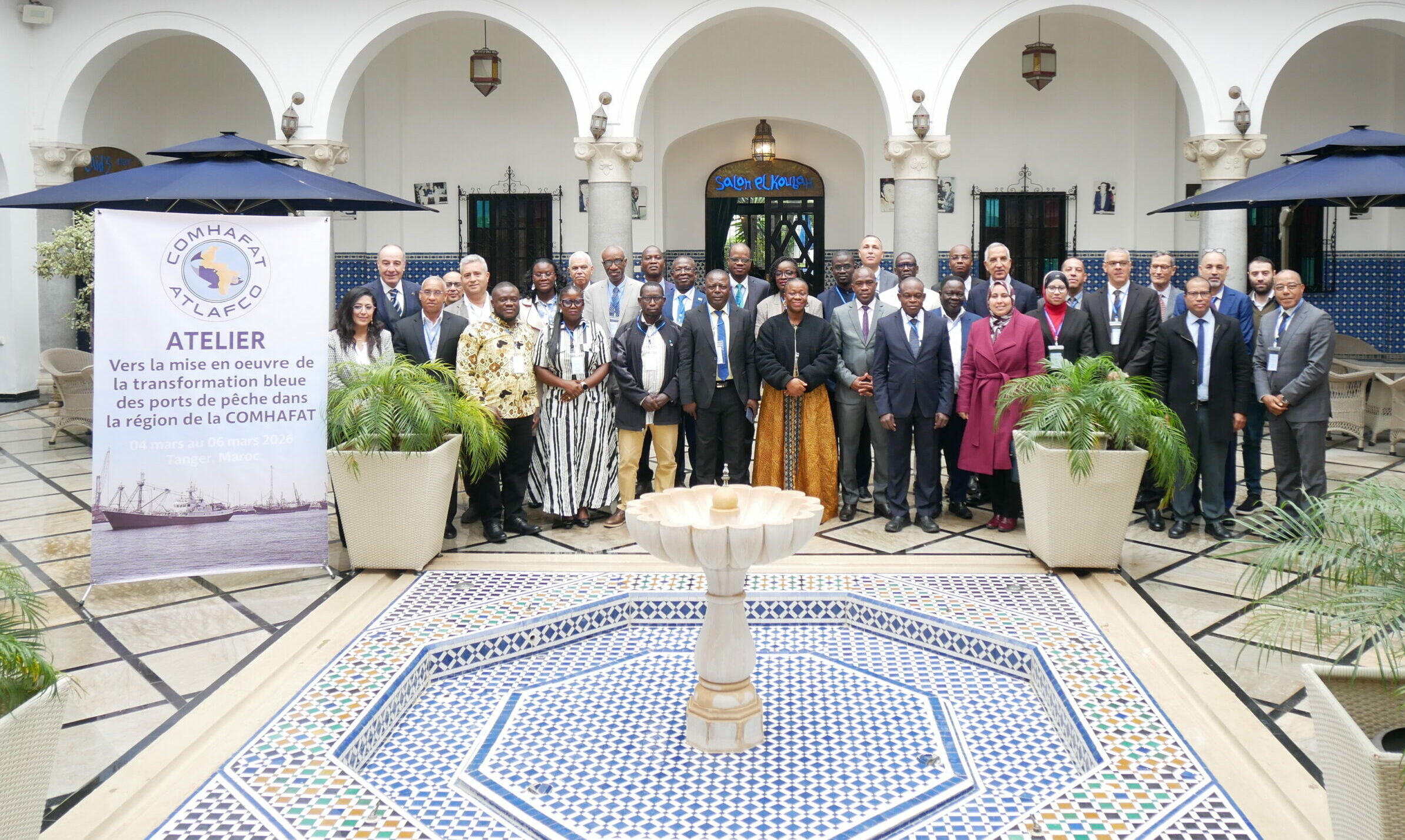
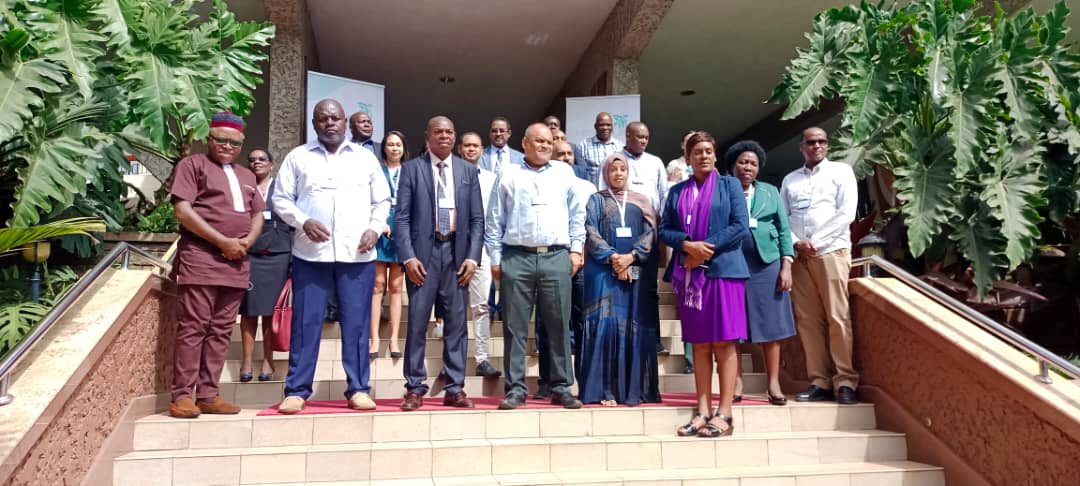
From 4 to 6 March 2026, the Moroccan port city of Tangier hosted a landmark gathering that could reshape the future of fisheries governance across Atlantic Africa. Convened by COMHAFAT/ATLAFCO, the workshop “Towards the Implementation of the Blue Transformation of Fishing Ports in the COMHAFAT Region” brought together policymakers, international experts and fishing-sector stakeholders from across the organisation’s member states. At the heart of the agenda: how to turn ageing port infrastructure into fully-fledged sustainable hubs , the so-called “Blue Ports” , balancing economic performance, marine ecosystem protection and inclusion for the full spectrum of fishing activity, from artisanal canoes to deep-sea industrial fleets.
Tangier, 6 March 2026 • By Naoufel Haddad, OMPDA/MOSFA
A High-Stakes Opening Ceremony
The strait city of Tangier set an apt stage for a three-day event that officials were quick to describe as a turning point. The opening ceremony of the COMHAFAT/ATLAFCO workshop drew delegates from member states stretching from Morocco and Mauritania in the north to Angola in the south, and from Senegal and Guinea-Bissau on the Atlantic seaboard to Nigeria and Cameroon in the Gulf of Guinea. Their shared mission: to agree on a workable blueprint for the “African Blue Port” model.
Mr Taoufik El Ktiri, Executive Secretary of COMHAFAT, opened the proceedings by reminding delegates of the organisation’s central mandate in the sustainable management of regional fisheries resources and the strategic importance of the workshop in delivering the 2025–2027 Action Plan. Mr Yassine Elaroussi, representing Morocco, made an impassioned case that ports are far more than logistics nodes — they are, in his words, “essential links in the fisheries chain,” social anchors and engines of sustainable development. The representative of COMHAFAT’s rotating presidency (Guinea) echoed that call, framing the moment in stark terms: “Transforming our ports today means securing the future of fishing across our entire region.”
Honest Stocktaking: Real Assets, Stubborn Challenges
The first technical session, chaired by Mr Abdennaji Laamrich, Head of the Cooperation and Information Systems Department at the COMHAFAT Secretariat, gave each delegation the floor to present the state of its national port infrastructure. The picture that emerged was one of striking contrasts: a region endowed with genuine strategic advantages , prime geographic location, centuries-old fishing traditions, and proximity to major export markets , yet weighed down by persistent bottlenecks. Ageing facilities, inadequate waste and effluent management, weak inter-stakeholder coordination, and over-dependence on external funding emerged as the defining challenges shared across the region.
A sobering contribution came from the International Maritime Organization (IMO), whose presentation on the OceanLitter programme (oceanlitter.imo.org) laid bare the scale of marine pollution driven by the fishing sector itself: abandoned nets, synthetic rope, and packaging waste rank among the leading sources of plastic contamination in the Atlantic off African shores. The operational remedies on display drew sustained attention from delegates who, in several cases, were seeing them for the first time.
Zarzis Takes Centre Stage: Hard Lessons from a Tunisian Pioneer
If a single presentation defined the intellectual tone of the workshop, it was the one delivered by Mr Naoufel Haddad, Secretary-General of the Observatory of Media for Sustainable Fisheries in Africa (OMPDA/MOSFA), on the Blue Port pilot project in Zarzis, Tunisia. Tunisia’s third-largest deep-sea fishing port, Zarzis accounts for 10 percent of the country’s national catch and sustains close to 3,000 livelihoods , making it a logical, if demanding, testbed for the FAO’s Blue Port framework.
Mr Haddad walked delegates through the framework’s three non-negotiable pillars: environmental (reducing ecological footprint, waste management, renewable energy), economic (fisheries value chains, innovation, food security) and social (decent working conditions, gender equality, youth and small-producer inclusion). What set Zarzis apart from a mere infrastructure upgrade, he argued, was the participatory co-construction of a local charter signed in May 2017 by every stakeholder at the table , the port authority, the regional agricultural commission, the fishers’ professional group, vessel owners, local NGOs and researchers from the INSTM marine research institute. That founding document enshrined a shared vision, guiding principles and governance mechanisms that no top-down blueprint could have produced.
The results were tangible. Thirteen micro-projects were launched targeting young people and women, providing economic alternatives to irregular migration , a scourge in the region. 160 fishers received training in business management, safety at sea and selective fishing techniques. But Mr Haddad did not shy away from the failures. He laid before the assembly three cardinal errors that other ports must avoid: imposing a one-size-fits-all Blue Port template without prior local diagnosis; reducing fishers to passive beneficiaries with no say in governance; and launching pilot projects without building in, from day one, mechanisms for financial self-sufficiency. His closing line cut through the room: “Fishers must be co-decision-makers, not spectators.”
Strategic Frameworks and National Roadmaps to 2030
Mr Delvis Fortes, representing AU-IBAR (the African Union’s Interafrican Bureau for Animal Resources), set the continental frame by presenting the African Blue Economy Strategy, stressing that responsible exploitation of marine resources is inseparable from regional cooperation, food security and sustainable employment in coastal communities.
Professor Jamal Machrouh of the Policy Center for the New South made the case for the Atlantic Initiative as a strategic lever for African port development. Maritime expert Mr Mohamed Merzagui drilled down into the legal architecture, spelling out how MARPOL compliance , and the installation of adequate port reception facilities to eliminate at-sea waste disposal , is a prerequisite for any port that aspires to the Blue Port label. The session closed with a presentation by Ms Sanae El Amrani, Morocco’s Director of Ports and Maritime Public Domain, whose account of the national port strategy to 2030 , integrating logistics modernisation with environmental sustainability , was met with genuine interest from delegations eager to benchmark their own plans against it.
Day Two: Best Practices and the Architecture of a Regional Roadmap
Thursday’s session, devoted to the FAO’s Blue Ports Initiative in detail, opened with Ms Yolanda Morales (FAO) presenting the step-by-step roadmap towards a Blue Port , a practical reference covering infrastructure modernisation, post-harvest loss reduction, food safety improvement and the integration of every fishing segment into the blue economy.
A rich parade of practitioners followed. Mr Eric Akaffou (INFOPÊCHE) demonstrated how the digital transformation of fish markets is revolutionising traceability and cutting post-catch losses. Ms Chaimaa Rabaoe of the Moroccan National Ports Agency showcased energy transition solutions already operational in Moroccan fishing ports. Mr Lahoucine Boudrari presented fishers’ villages as blueprints for community service hubs serving artisanal fleets. And Mr Nabil Anwari surveyed the financing landscape, highlighting the potential of national Blue Port funds built on progressive subscription mechanisms to wean ports off donor dependency.
Round tables facilitated by Dr Ali Domtani produced a draft regional roadmap organised around three strategic axes: strengthening national and regional governance, scaling technological innovation, and mobilising sustainable financing. The declared ambition was unambiguous , to create a standardised, transferable “African Blue Port Label”, anchored in national fisheries and blue economy policies and aligned with SDG 14 (Life Below Water) and the 2030 Agenda.
Day Three: Tangier’s Fish Market , Africa’s Digital Catch in Action
The final day moved from theory to the quayside. Led by Mr Abdelaziz Sibaouaih of the Office National des Pêches (ONP) in Tangier, delegates stepped into one of Africa’s most technologically advanced fish auction halls , a living proof of concept for the Blue Port vision.
The system leaves nothing to chance. From the moment a vessel docks, every catch is identified, weighed and logged in a connected system that feeds a centralised platform tracking full chain-of-custody from hold to consumer. Auctions are entirely digitalised: registered buyers submit bids on networked terminals, ensuring price transparency and eliminating the informal brokers who have long skimmed margins from fishers’ earnings. Payments flow directly to the fishers’ bank accounts. The ONP model is not merely impressive , it is, crucially, replicable, and several delegations left Tangier already discussing how to adapt it to their own ports.
The group also visited the Dalia Artisanal Landing Site (PDA), where tailored infrastructure enables small-scale fishers to operate efficiently within hygiene and environmental standards. Together, the two sites embodied what the preceding two days had argued in the abstract: that world-class port infrastructure can and must serve every fishing community, from the owner of a dugout canoe to the captain of a deep-water trawler.
Collective Resolve , and a New Ambition for African Ports
When delegates gathered for the closing session, the mood was one of purposeful momentum rather than polite consensus. Over three days, participants had done the hard work of mapping a collective path , from diagnostic to governance, from finance to technology , towards a Blue Port model calibrated to the full diversity of the COMHAFAT region, from its smallest artisanal communities to its largest industrial fishing operations.
The commitments on the table are concrete: institutionalising participatory port governance structures, adopting shared SMART indicators to track progress, fast-tracking the digital transformation of auctions and traceability systems, and establishing national funding vehicles to end chronic reliance on external donors. Overarching all of this is the lesson that Zarzis taught most powerfully , that durable transformation begins with a rigorous participatory diagnosis, places fishing communities at the decision-making table, and derives its long-term legitimacy from alignment with national fisheries and blue economy policies.
“This workshop is a historic milestone,” Mr Taoufik El Ktiri told delegates at the close. “COMHAFAT and its member states have built a shared vision. It is working towards the concerted and sustainable management of regional fisheries resources. The FAO Blue Ports Initiative aims to transform fishing port infrastructure into sustainable development hubs serving the full spectrum of fishing activity.”
Naoufel Haddad